
 Delivery and payment









-100x100.png)
-100x100.png)





















































- What inositol is for – what it is – What is inositol in simple terms – What forms of inositol exist – How inositol works in the body
- What inositol is for – main purpose and signs of deficiency – Why people take inositol and when the body needs it – Signs of inositol deficiency
- What inositol is for – benefits for the body – Nervous system support and anxiety reduction
- What inositol is for – effects on hormones – Hormonal balance regulation and inositol for PCOS – Impact on insulin resistance
- What inositol is for – for women – Benefits for reproductive health, cycle, and pregnancy planning
- What inositol is for – for the brain and mental health – Effects on mood, cognitive function, and help with depression
- What inositol is for – for metabolism – Effects on metabolism, weight loss, and blood sugar
- What inositol is for – forms and types – Myo-inositol, D-chiro-inositol, and which form is better
- What inositol is for – how to take it – Recommended dosage and time of intake
- What inositol is for – side effects and contraindications – Possible reactions, who should avoid it, and overdose – Interactions with medications
- What inositol is for – how to choose a quality product – What to look for and how to avoid counterfeits
- What inositol is for – comparison with other supplements – Inositol vs magnesium, B vitamins, and adaptogens
- What inositol is for – pros and cons – Advantages – Disadvantages and who it suits best
- What inositol is for – tips for effective use – How to improve absorption, what to combine it with, and common mistakes
- What inositol is for – FAQ – Can it be taken daily and how soon the effect is noticeable – Does it help with PCOS and what is a safe dosage
- Sources
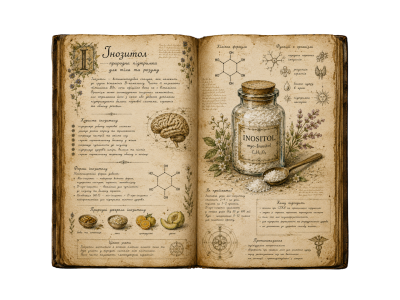
Inositol is a vitamin-like substance that our body produces on its own, but not always in sufficient amounts. Why inositol is taken as a supplement: to support the nervous system, hormonal balance, and mental well-being. Especially popular is myo-inositol—why it’s used: it is part of the first-line nutritional support for PCOS, anxiety, and insulin resistance. In this article, we’ll cover inositol’s properties, effects, rules of use, and contraindications.
What inositol is for – what it is
What is inositol in simple terms
Inositol is a cyclic alcohol structurally similar to glucose. It is sometimes called “vitamin B8,” although officially it is not a vitamin: the body synthesizes it on its own from glucose. Inositol is present in cell membranes, the brain, heart, kidneys, and reproductive organs. Without it, signaling between cells does not work—particularly signaling from insulin and neurotransmitters.
What forms of inositol exist
There are nine stereoisomers, but two are physiologically active: myo-inositol (Myo-inositol) is the most common form in the body and the basis of cellular signaling; and D-chiro-inositol is present in smaller amounts and is critically important for glucose metabolism and glycogen synthesis. Their combination in a 40:1 or 20:1 ratio (myo:D-chiro) showed the best results in clinical studies for PCOS.
How inositol works in the body
An inositol supplement acts as a secondary messenger: it transmits the signal from hormones (insulin, FSH, TSH) into the cell. Without sufficient inositol levels, the cell “doesn’t hear” the hormone even when its blood level is normal. This explains why in PCOS and insulin resistance—conditions where signaling is impaired—the supplement has such a noticeable effect.
What inositol is for – main purpose and signs of deficiency
Why people take inositol and when the body needs it
Most often, inositol is used for: PCOS and ovulation disorders, insulin resistance and prediabetes, anxiety disorders and panic attacks, OCD (obsessive-compulsive disorder), depression, sleep disturbances, and fertility support when planning pregnancy. The need increases with chronic stress, a high-sugar diet, use of certain antidepressants, and in diabetes.
Signs of inositol deficiency
There is no specific blood test for inositol in routine clinical practice. But indirect signs include: chronic anxiety without an apparent reason, cycle irregularities in women, difficulty losing weight despite proper nutrition, poor sleep, and elevated fasting insulin—these conditions may indicate a functional deficiency.

What inositol is for – benefits for the body
Nervous system support and anxiety reduction
Inositol supports the nervous system via serotonin and noradrenaline signaling. It increases receptor sensitivity to serotonin—not by raising its level, but by improving how well cells “hear” it. A clinical study by Belmaker et al. (Archives of General Psychiatry, 1995) showed that 12 g of inositol per day significantly reduced symptoms of panic disorder—an effect comparable to fluvoxamine, but without typical antidepressant side effects.
Inositol improves sleep by reducing anxiety and normalizing neurotransmitter balance. Most people notice easier falling asleep within 2–3 weeks of use.
What inositol is for – effects on hormones
Hormonal balance regulation and inositol for PCOS
Inositol regulates hormones by improving sensitivity to insulin and FSH. In PCOS—polycystic ovary syndrome—ovarian cells respond poorly to FSH due to impaired inositol signaling. Myo-inositol restores this sensitivity: ovulation returns, the cycle normalizes, and androgen levels decrease.
A 2020 meta-analysis (Pundir et al., BJOG)—13 randomized studies, over 1,000 women—found that inositol for PCOS significantly improved ovulation frequency, reduced testosterone levels, and improved insulin sensitivity compared with placebo.
Impact on insulin resistance
Inositol and insulin are a key link. D-chiro-inositol is a mediator of insulin signaling in muscle and adipose tissue. In insulin resistance, its level is reduced. Taking D-chiro or a combined formula restores signaling and reduces baseline insulin by 20–30% over 12–16 weeks, according to clinical studies.
What inositol is for – for women
Benefits for reproductive health, cycle, and pregnancy planning
Inositol for women is one of the most evidence-based nutritional strategies for hormonal issues. Restoring ovulation: in women with PCOS, after 3–6 months of myo-inositol use, ovulation returned in 70–80% of cases (Raffone et al., 2010). Cycle normalization: shorter irregular cycles and reduced menstrual pain. Oocyte quality: myo-inositol improves egg quality, which is critical for IVF—several studies reported a higher percentage of successful fertilizations.
Inositol when planning pregnancy: the recommended course is 3–6 months before conception. Doses: myo-inositol 4 g/day + D-chiro 400 mg/day or a combined product in a 40:1 ratio.
What inositol is for – for the brain and mental health
Effects on mood, cognitive function, and help with depression
Inositol reviews from people with anxiety disorders are mostly positive—and this is supported by scientific evidence. It reduces excessive amygdala activation (the brain’s anxiety center), improves sleep quality, and provides a sense of “grounding” without a sedative effect. In obsessive-compulsive disorder, 18 g/day reduced the frequency of intrusive thoughts—data from Fux et al. (American Journal of Psychiatry, 1996).
Cognitive support: inositol supports the myelin sheaths of nerves, which is important for the speed and accuracy of signal transmission. This is especially relevant for “brain fog” caused by chronic stress or hormonal disorders.

What inositol is for – for metabolism
Effects on metabolism, weight loss, and blood sugar
Inositol for weight loss works by reducing insulin resistance: lower baseline insulin = less fat storage = easier weight loss with a calorie deficit. Women with PCOS and insulin resistance who took myo-inositol for 6 months lost an average of 2–4 kg more than placebo—not because it “burns fat” directly, but by normalizing hormonal background.
Blood sugar control: inositol lowers insulin without the risk of hypoglycemia—it doesn’t stimulate the pancreas, but improves tissue response. This is especially important in prediabetes.
What inositol is for – forms and types
Myo-inositol, D-chiro-inositol, and which form is better
| Form | Main action | When to choose |
|---|---|---|
| Myo-inositol | Nerves, ovaries, anxiety, sleep | For most people – first choice |
| D-chiro-inositol | Glucose metabolism, androgens | PCOS with insulin resistance |
| Combination 40:1 | Comprehensive action for PCOS | Optimal for PCOS and IVF |
For most goals—nervous system, sleep, anxiety—myo-inositol 2–4 g/day is sufficient. For PCOS and insulin resistance—a combined formula.
What inositol is for – how to take it
Recommended dosage and time of intake
Inositol dosage depends on the goal:
| Goal | Dose per day |
|---|---|
| Anxiety, sleep, nerves | 2–4 g myo-inositol |
| PCOS, restoring ovulation | 4 g myo + 400 mg D-chiro (40:1) |
| Insulin resistance | 2–4 g myo or a combined formula |
| Cognitive support | 2 g myo in the morning |
When it’s best to take it: for sleep and anxiety—in the evening 30–60 minutes before bed. For hormonal goals—morning and evening, splitting the dose in half. Take with water or juice, not with milk (it competes for transport). Start with 2 g; after a week, increase to the target dose.
What inositol is for – side effects and contraindications
Possible reactions, who should avoid it, and overdose
Inositol side effects are minimal at recommended doses. Most often: mild nausea or abdominal discomfort at the beginning (passes in 3–5 days), rarely—gas, loose stools at doses above 12 g. Inositol contraindications: pregnancy (without a doctor’s approval), lithium use (interaction), manic phase of bipolar disorder. During breastfeeding—insufficient data. Oral overdose is practically safe—excess is excreted in urine, but doses above 30 g/day cause pronounced GI reactions.

Interactions with medications
Inositol may weaken the effect of lithium medications (used in psychiatry). If taking antidepressants, consult a psychiatrist before starting. With metformin—synergy for insulin resistance, but excessive effects on insulin levels are possible.
What inositol is for – how to choose a quality product
What to look for and how to avoid counterfeits
It’s best to buy inositol as a pure powder or capsules without unnecessary fillers. What to check: form (myo, D-chiro, or combo), dose of elemental inositol per serving (not the capsule weight), GMP or NSF quality certification, absence of artificial colors and sweeteners. Buy inositol from trusted brands: Jarrow Formulas, Seeking Health, Pure Encapsulations, Fairhaven Health—all publish a COA (certificate of analysis).
What inositol is for – comparison with other supplements
Inositol vs magnesium, B vitamins, and adaptogens
| Comparison | Similarity | Difference |
|---|---|---|
| Inositol vs magnesium | Both for nerves and sleep | Inositol – hormones, PCOS; magnesium – muscles, energy |
| Inositol vs B vitamins | Nervous system, mood | Inositol – signaling pathways; B vitamins – enzymes |
| Inositol vs adaptogens | Reducing anxiety | Inositol – receptor sensitivity; adaptogens – HPA axis |
These supplements don’t replace one another—they complement each other. An optimal combination for PCOS: myo + D-chiro inositol + magnesium glycinate + vitamin D.
What inositol is for – pros and cons
Advantages
- Strong evidence base for PCOS.
- Safe for long-term use.
- No dependence or withdrawal syndrome.
- Dual action—both on mental health and hormones.
- Suitable for a long course.
Disadvantages and who it suits best
Disadvantages: the effect appears after 4–12 weeks (not instantly), a high therapeutic dose requires a quality product, and it’s not suitable while taking lithium without consultation. Who it suits best: women with PCOS and irregular cycles, people with anxiety and panic attacks, those with insulin resistance, women planning pregnancy or undergoing IVF.

What inositol is for – tips for effective use
How to improve absorption, what to combine it with, and common mistakes
Take with water or juice, not with dairy products. Split the daily dose into two intakes—morning and evening. Combine with folic acid when planning pregnancy, with magnesium for anxiety and insomnia, and with vitamin D for PCOS (a shared deficiency is common).
Common mistakes: expecting an effect in a week—real results for PCOS take 3–6 months; taking only myo with pronounced insulin resistance—a combo formula is needed; buying a cheap product without specifying the form of inositol.
What inositol is for – FAQ
Can it be taken daily and how soon the effect is noticeable
Yes, daily intake is the norm and the recommendation to reach therapeutic levels. Inositol effects: for sleep and anxiety—after 2–3 weeks. For cycle and hormones in PCOS—after 3–6 months. For insulin levels—after 8–12 weeks.
Does it help with PCOS and what is a safe dosage
Yes, inositol for PCOS is one of the most well-documented nutritional approaches. The effect is confirmed by multiple RCTs. Safe dosage for adults: myo-inositol up to 18 g/day in clinical settings; standard maintenance dose 2–4 g/day. Inositol is a substance with no toxic threshold when taken orally by healthy people.
Sources
- Pundir J. et al. Inositol treatment of anovulation in women with polycystic ovary syndrome. BJOG, 2018.
- Belmaker R.H. et al. Inositol treatment of panic disorder. Archives of General Psychiatry, 1995.
- Fux M. et al. Inositol treatment of obsessive-compulsive disorder. American Journal of Psychiatry, 1996.
- Raffone E. et al. Insulin sensitiser agents alone and in co-treatment with rFSH for ovulation induction. Gynecological Endocrinology, 2010.
To choose a quality inositol for your goal—Lavka Molfara offers verified options of myo-inositol and combined formulas.




Write a comment