
 Delivery and payment





-100x100.png)
-100x100.png)








































- What a severe cough is and when it’s dangerous
- Cough causes — which are most common
- Types of cough
- Severe cough: how to treat it at home — folk remedies
- Pharmacy remedies: over-the-counter medications
- Inhalations — steam and nebulizer
- Lifestyle during illness
- Children’s cough — why self-treatment is dangerous
- Severe cough in adults — effective methods
- When you need to see a doctor
- Cough prevention
- Tips for faster recovery
- FAQ – How to quickly cure a severe cough? – Can you treat a cough without medications? – How long does a severe cough last? – Which remedies are the most effective?
- Sources
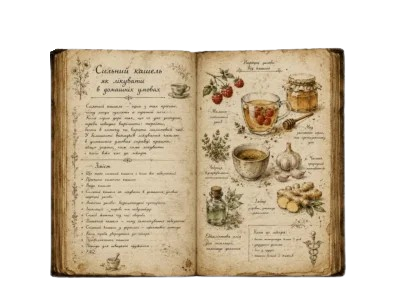
Severe coughing is one of those reasons why people google at three in the morning. When your throat burns so much that you can’t fall asleep, you need to decide quickly: endure it, run to the pharmacy, or brew raspberry tea. The query “how to treat a cough at home” is typed in Ukraine hundreds of thousands of times every month — and in most cases, treating a cough at home really works, if you know exactly what to treat a cough at home with and when it’s time to see a doctor.
.png)
Let’s go through everything in order: types of cough, what to drink for a cough, which home remedies for cough actually help, and where the line is after which “what to do about a cough at home” is no longer an option.
What a severe cough is and when it’s dangerous
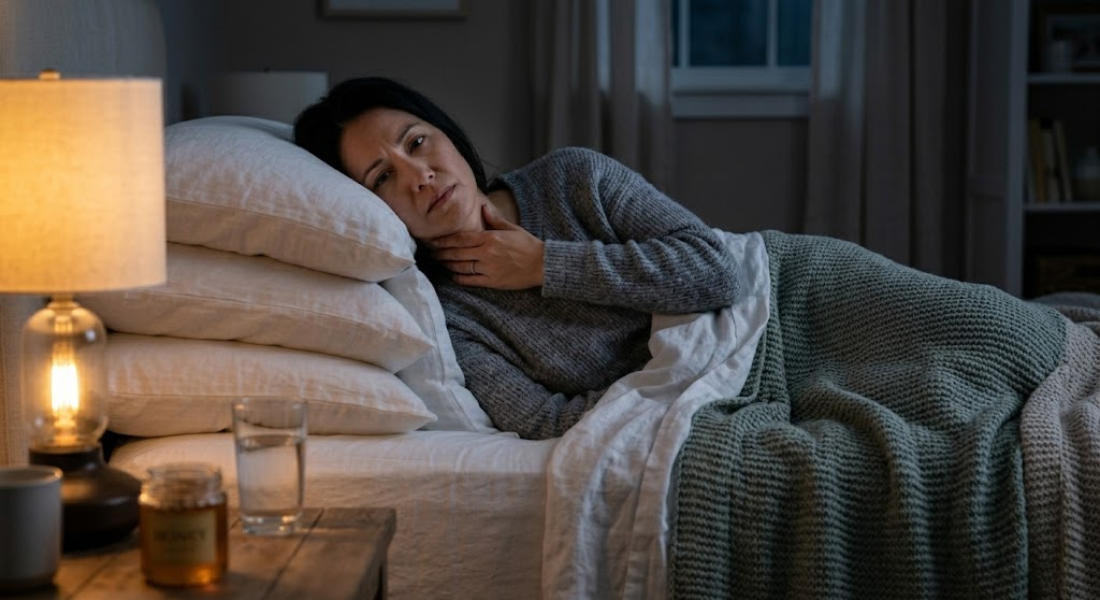
You can’t fall asleep, your chest feels raw, your abdominal muscles hurt from the attacks. That’s a severe cough — the kind that makes people read medical forums at three in the morning.
By itself, a cough is a protective reflex, not a disease. The body is expelling mucus, dust, and viruses from the airways. The problem starts when the reflex “gets stuck” and lasts longer than it should.
You can treat a cough at home if the temperature is not above 38.5°C, there is no shortness of breath at rest, and the sputum is clear or whitish-yellow, without blood. Anything else is a reason to call a doctor.
Cough causes — which are most common
The most common is a viral infection. ARVI, flu, adenovirus, covid inflame the airway mucosa, and the body responds with coughing. 5–10 days — and it goes away on its own.
The second category is allergies and irritants: dust, mold, animal dander, tobacco smoke, dry air in a heated room. Often accompanied by an itchy nose and sneezing. They do not respond to antibiotics.
The third is bacterial complications: bronchitis, pneumonia, sinusitis. Here you already need a doctor: you won’t be able to tell bronchitis from complicated ARVI on your own.
A separate case is a cough without fever. Allergy, residual cough after a virus (3–6 weeks), acid reflux, or asthma. Longer than a month — see a pulmonologist.
Types of cough
Dry and wet are the main classification. A dry cough is “scratching,” without discharge, exhausting, worse at night. A wet cough is with sputum; after coughing up it feels easier. The first is calmed, the second is helped to clear.
A cough at night often gets worse because mucus from the nasopharynx drains into the throat in a horizontal position. A high pillow, a ventilated room, and humidified air help.
By duration: acute — up to 3 weeks, subacute — 3–8 weeks, chronic — over 8. A prolonged cough requires different treatment: the usual syrup doesn’t help here; you need to look for the cause with a doctor.
| Type of cough | How it presents | Basic approach |
|---|---|---|
| Dry cough treatment | No sputum, “scratching” | Soothing remedies, warm drinks |
| Wet cough treatment | With mucus production | Mucolytics, expectorants |
| Cough at night | Worsens in a horizontal position | Humidification, high pillow |
| Prolonged | Lasts more than 3 weeks | Doctor’s diagnostics are required |
Severe cough: how to treat it at home — folk remedies
Treating a cough with folk remedies is a whole industry in which some methods work and some are passed down from generation to generation simply by inertia. The base on which everything else is built: warm drinks, honey, and humid air. Individually each component does less; together they’re the best home cough remedy.
Honey. One of the few folk remedies with a real evidence base. A 2021 meta-analysis in BMJ Evidence-Based Medicine showed: honey for ARVI works better than most OTC syrups. A teaspoon before bed — and the cough quiets for a few hours. “A natural antibiotic for cough” is what it’s called, though more accurately it’s a “local antimicrobial agent”: it doesn’t act systemically, but it coats the throat and suppresses bacteria in the mouth and pharynx.
Cough tea at home. Ginger with lemon, linden, chamomile, thyme. Hot liquid moisturizes the mucosa and thins mucus. Also here — warm milk with honey and butter. Grandma’s classic, which evidence-based medicine doesn’t argue against.
What to drink for a cough besides tea: rosehip decoction, dried-fruit compote, broth. Plain water also counts — at least 2 liters per day.
And here are folk cough remedies to avoid: mustard plasters (can burn), cupping (traumatic), rubbing with vodka (doesn’t work through the skin for an adult). Rituals passed down for generations, but with zero benefit.
Pharmacy remedies: over-the-counter medications
Treating a dry cough at home with the help of the pharmacy starts with choosing the right syrup. Cough syrup is chosen by type. For dry cough — products with dextromethorphan, butamirate, ivy, or marshmallow root. For wet cough — mucolytics (ambroxol, acetylcysteine) and expectorants.
Two types of cough medicines don’t mix well. If you take a mucolytic and at the same time “suppress” the cough with an antitussive — the sputum thins, but has no way to get out. This can speed up bronchitis.
Internet reviews often praise specific brands as the most effective for cough. Don’t trust them 100% — reactions are individual. If a drug gives no effect in 3–4 days, switch it.
From the obvious things that bring immediate relief — lozenges with menthol or eucalyptus. If you ask a pharmacist what helps a cough at lunchtime before a meeting — this is the most common answer.
Inhalations — steam and nebulizer
Inhalations for cough are divided into two types with different logic.
Steam — over a pot of hot water, with baking soda or a decoction of chamomile/eucalyptus. They moisturize the mucosa and ease a dry cough. Keep a towel over your head for 5–7 minutes, no more. In ICUs, by the way, they’ve long been doing the same thing, just with technically correct equipment — the essence hasn’t changed since our grandmothers’ days.
Nebulizer — a more serious device. It sprays liquid into fine particles that penetrate the lower airways. Solution: saline (NaCl 0.9%) for moisturizing, Ambrobene for expectoration, anything else — by prescription.
What you must not pour into a nebulizer: essential oils (ruin the device and harm the lungs), herbal decoctions with particles, syrups. Only special pharmacy solutions.
Lifestyle during illness
What to treat a cough at home with is important, but no less important is how exactly to live during these days.
Drinking. At least 2–2.5 liters of fluid per day. Tea, broth, compote — everything counts.
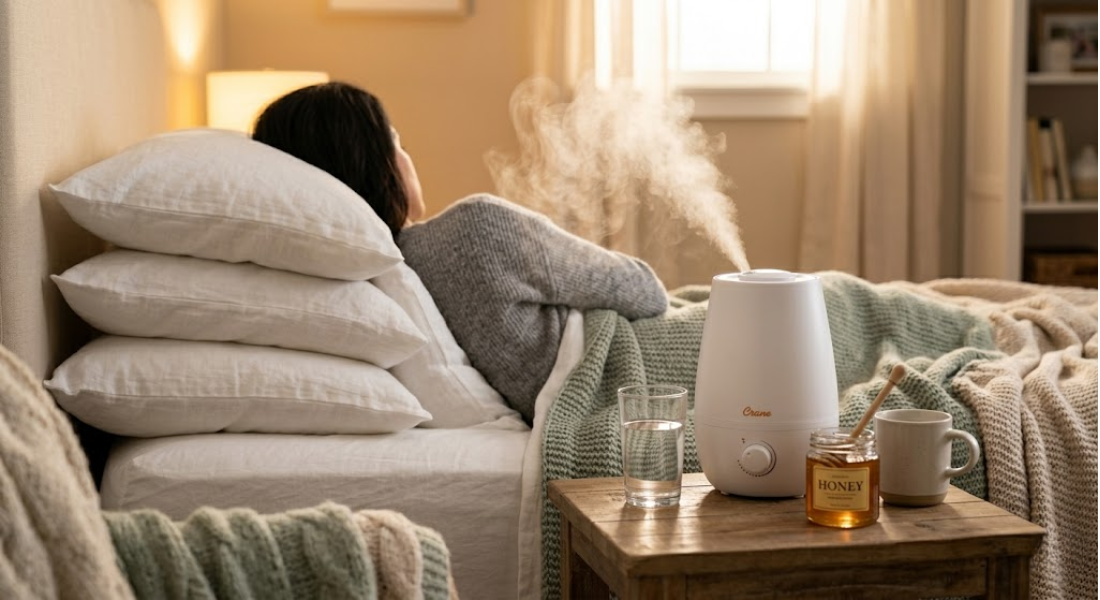
Air humidification. In winter, with heating, humidity drops to 20–30% instead of the normal 45–60%. The mucosa dries out, the cough worsens. A humidifier or a bowl of water on the radiator.
Rest. Because how else. “I’ll beat the cough and go to work” is an old classic, after which the illness drags on twice as long. Most doctors, if you ask honestly, put not syrups first, but 8–9 hours of sleep.
Children’s cough — why self-treatment is dangerous
If your child has a severe cough, don’t try to cure your child’s cough at home on your own. How to cure a child’s cough at home is a question with only one correct answer: a child’s cough should be treated only under a pediatrician’s supervision.
Why this is essential:
- What’s safe for an adult can harm a child. Honey is forbidden under 1 year (risk of botulism). Dextromethorphan and codeine are unacceptable under 6 years.
- A child’s cough can quickly turn into bronchitis or pneumonia.
- “Just a cough” in a child may hide croup, bronchiolitis, or a foreign body.
Rule: a child with a severe cough — to the pediatrician the same day. Until then — warm drinks and a ventilated room. No syrups without a prescription.
.png)
Severe cough in adults — effective methods
Treating an adult’s cough requires a different approach than a child’s. How to cure a cough quickly at home for an adult is a matter of combination.
A working 3–5 day at-home cough treatment plan: warm drinks every 2 hours → inhalations with saline 2 times a day → syrup according to cough type → humidifier → 8+ hours of sleep → vitamin C 500–1000 mg/day and zinc 15–25 mg.
How to stop coughing at night: a spoonful of honey 30 minutes before sleep, air the room, sleep on a high pillow. Runners I know with autumn cough after marathons swear by this set — and it’s cheaper and more reliable than expensive syrups.
What ruins treatment: antibiotics “just in case” (don’t work on viruses), cold drinks “to numb the throat” (only cause spasm), smoking “because it’s easier to breathe” (drags the process out by an extra week).
When you need to see a doctor
Serious red flags where self-treatment should stop:
- Temperature above 38.5°C for more than 3 days
- Cough with blood or rusty sputum
- Shortness of breath at rest or with minimal exertion
- Chest pain when coughing
- Cough lasts longer than 3 weeks
- Wheezing that can be heard from a distance
- Unexplained weight loss
Even one item — and book an appointment with your family doctor the same day. Every doctor can tell their own story about acquaintances who “thought it was ARVI for two weeks” and ended up with pneumonia and hospitalization.
Cough prevention
Strengthening immunity rests on boring habits: 7–8 hours of sleep, fruits and vegetables daily, walks, moderate movement, seasonal flu and covid vaccination. No superfoods.
Protection from viruses and allergens: wash hands after going outside, air the room 2–3 times a day, during allergy season keep windows closed in the morning. For smokers: every day you smoke is minus a few days of life and plus the risk of chronic bronchitis.
Tips for faster recovery
How to cure a cough in 1 day? No way. It’s biology, not advertising. A realistic recovery time for ARVI is 5–10 days, for bronchitis — 2–3 weeks. Anything that promises faster is selling hope.
What speeds up recovery:
- Don’t go to work sick
- Don’t “hammer down” the symptom with meds while ignoring the cause
- Don’t overuse sprays (more than 5–7 days dries the mucosa)
- Don’t take antibiotics “just in case”
How to get rid of a cough at home for good: see it through to the end. After 3 days it gets easier — and the person returns to a full pace, and on day 6 the cough comes back twice as strong. Give yourself a week.
FAQ
How to quickly cure a severe cough?
Realistically — in 5–7 days, with a combination: warm drinks + inhalations + syrup + sleep. The query “cough treatment fast in a day or two” usually ends with the person still being sick for a week, plus minus 500 UAH spent on ineffective remedies.
Can you treat a cough without medications?
For most ARVI — optimally, yes. Warm drinks, honey, rest, humidifier. Medications are needed when the cough is severe, prevents sleep, or doesn’t go away in 7–10 days.
How long does a severe cough last?
Acute — up to 3 weeks. If it lasts longer — a reason to see a doctor.
Which remedies are the most effective?
The most effective cough treatment is when hydration, air humidification, honey, a syrup matched to your cough type, and proper sleep work together. Individually, each component has a modest effect.
Sources
- Oduwole O. et al. Honey for acute cough in children. Cochrane Database of Systematic Reviews, 2018.
- Abuelgasim H. et al. Effectiveness of honey for symptomatic relief in upper respiratory tract infections. BMJ Evidence-Based Medicine, 2021.
- American College of Chest Physicians, Cough Guidelines, 2020.
- WHO, Acute respiratory infections in primary care, 2019.
- CDC, Common Colds: Protect Yourself and Others, 2023.
Cough is a symptom that rarely requires heroics. It goes away on its own or with minimal help from a home medicine kit. If it lasts longer than expected or “red flags” appear — don’t delay seeing a doctor. At Lavka Molfara you can choose herbal teas and companion remedies for adults that will help speed up recovery.
Write a comment