
 Delivery and payment









-100x100.png)
-100x100.png)





















































- How to take fish oil capsules – what it is – What fish oil is and its main components
- How to take fish oil capsules – what it is for – Benefits for the heart, brain, and immunity
- How to take fish oil capsules – benefits for the body – Skin, hair, joints, and energy
- How to take fish oil capsules – dosage – Daily allowance and calculating an individual dose
- How to take fish oil capsules – when it’s best to take them – Before or after meals, morning or evening
- How to take fish oil capsules – how to take them correctly – What to drink them with, what to combine with, and the course
- How to take fish oil capsules – for women and men – Benefits and specifics of intake
- How to take fish oil capsules – for children – Age, dosage, and what to consider
- How to take fish oil capsules – side effects and contraindications – Reactions, overdose, and who should not take it
- How to take fish oil capsules – how to choose a quality product – Omega-3 concentration and purification quality
- How to take fish oil capsules – comparison with other forms – Capsules vs liquid fish oil
- How to take fish oil capsules – tips for effectiveness – How to improve absorption, what to combine with, and common mistakes
- How to take fish oil capsules – FAQ – Can you take fish oil every day – How long until you see an effect – Can you take it on an empty stomach – What omega-3 dosage is optimal
- Sources

“How to take fish oil” is one of the most popular search queries in the supplements category. Not everyone knows how to take fish oil capsules correctly: some swallow a capsule on an empty stomach and then wonder why they feel nauseous, others take too little and don’t get any effect. How to take fish oil capsules depends on your goal, the dose, and the product form. Let’s break it down clearly.
How to take fish oil capsules – what it is

What fish oil is and its main components
Fish oil is a fat obtained from the tissues of fatty marine fish: salmon, sardines, mackerel, anchovy. The main value is omega-3 fatty acids, primarily EPA (eicosapentaenoic) and DHA (docosahexaenoic). These are responsible for anti-inflammatory, cardioprotective, and neuroprotective effects.
Capsules differ from the liquid form in convenience, the absence of a fishy taste when taken, and a longer shelf life. The gelatin shell protects fatty acids from oxidation and dissolves only in the stomach—so there is almost no fishy breath. Fish oil capsules are significantly more beneficial in terms of sticking to a course than the liquid form.
How to take fish oil capsules – what it is for
Benefits for the heart, brain, and immunity
Omega-3 for the body is, first and foremost, cardiovascular protection. A 2019 meta-analysis (NEJM) of more than 25,000 participants showed that regular omega-3 intake reduced the risk of heart attack by 28%. EPA lowers triglyceride levels; DHA supports blood vessel elasticity and regulates heart rhythm.
For the brain and nervous system: DHA makes up about 40% of the brain’s polyunsaturated fatty acids. A deficiency worsens memory and concentration and increases the risk of depression. Regular fish oil intake supports cognitive function and reduces inflammatory markers associated with neurodegeneration. For immunity, omega-3s modulate prostaglandin production and reduce systemic inflammation.
How to take fish oil capsules – benefits for the body
Skin, hair, joints, and energy
Fish oil capsules benefit the skin by reducing inflammation (for acne and psoriasis) and supporting hydration. DHA and EPA strengthen skin cell membranes, helping retain moisture and elasticity. For hair and nails, both substances nourish hair follicles and the nail matrix.

For joints: omega-3s reduce the synthesis of pro-inflammatory mediators—leukotrienes and prostaglandins. In rheumatoid arthritis, regular intake reduces morning stiffness and pain. For energy: EPA is involved in mitochondrial metabolism, supporting cellular energy exchange.
How to take fish oil capsules – dosage
Daily allowance and calculating an individual dose
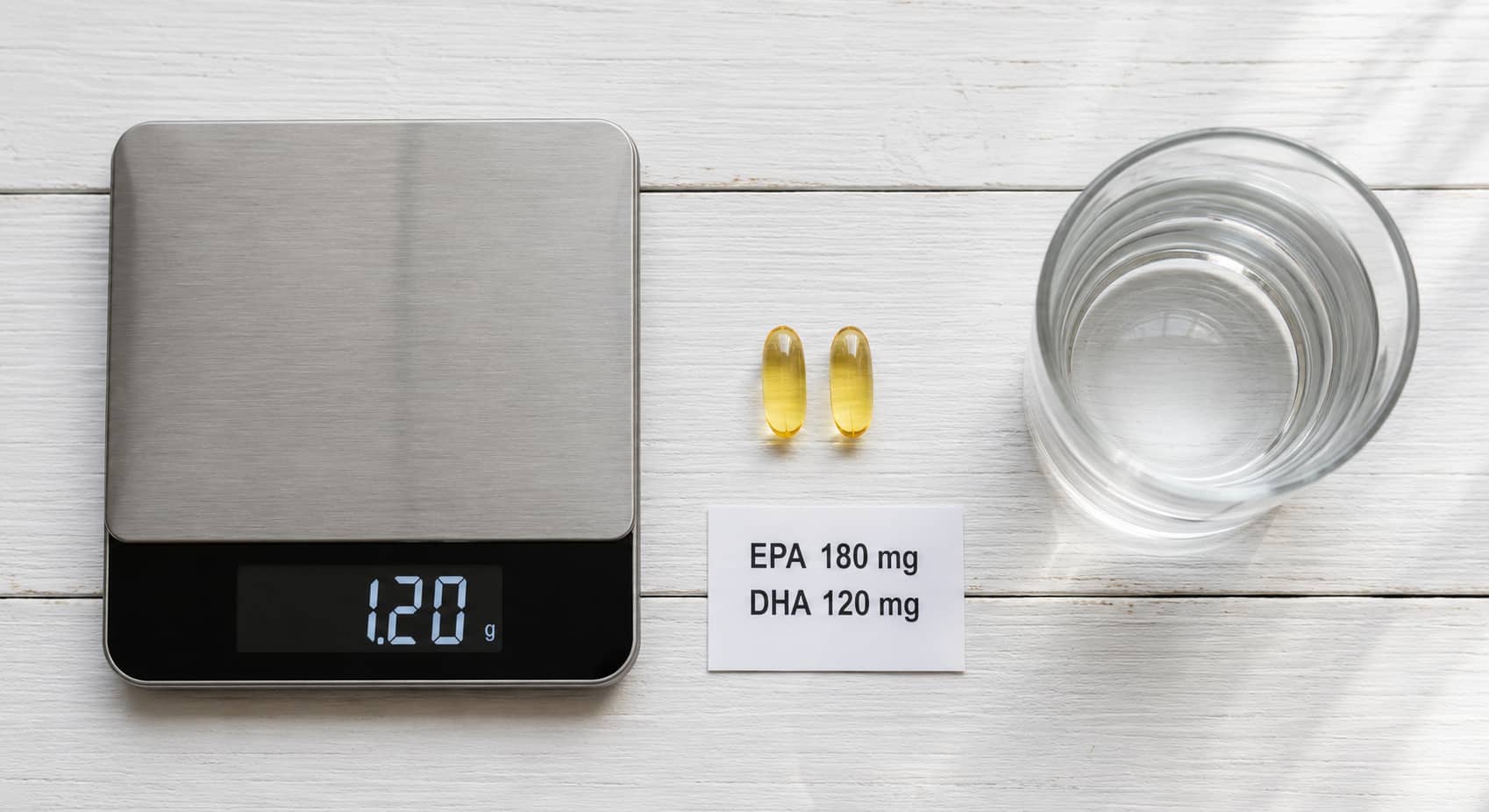
How to take fish oil by dosage is the key question. You need to look not at the capsule weight, but at the omega-3 content (EPA + DHA) in it. A standard 1000 mg capsule usually contains 300 mg of omega-3 (EPA+DHA). These are not the same thing.
| Goal / group | Daily EPA+DHA dose |
|---|---|
| General prevention, healthy adults | 500–1000 mg/day |
| Cardiovascular risks | 1000–2000 mg/day |
| High triglycerides (under a doctor’s supervision) | 2000–4000 mg/day |
| Children 2–12 years | 250–500 mg/day |
| Pregnant women (only with a doctor) | 200–300 mg DHA/day |
With 300 mg of omega-3 per capsule, 1–2 capsules per day are enough for prevention. For therapeutic purposes, 3–6 capsules. Always look at the EPA+DHA content, not the capsule weight.
How to take fish oil capsules – when it’s best to take them
Before or after meals, morning or evening
Fish oil before or after meals—definitely after or during a fatty meal. Fats in food stimulate bile production, which helps break down and absorb omega-3. Taking it on an empty stomach is not recommended: the risk of nausea increases and absorption decreases.
Morning or evening—there is no fundamental difference. If you take it to support the brain and concentration, it’s better in the morning. To improve sleep and reduce inflammation, in the evening. The main rule is to take it with food containing fats. The daily dose can be split into two intakes—morning and evening.
How to take fish oil capsules – how to take them correctly
What to drink them with, what to combine with, and the course
How to take fish oil capsules correctly: take with room-temperature water or any caffeine-free drink. Do not take with hot drinks—it breaks down the оболонку too early.
How to take with other supplements: it combines well with vitamin D (synergy for immunity and bones), vitamin E (an antioxidant that protects omega-3 from oxidation), magnesium, and coenzyme Q10. Do not combine with anticoagulants without a doctor.
Course of intake: optimally 3 months continuously, then a 1-month break. Daily intake without breaks is acceptable at preventive doses (up to 1 g of omega-3 per day) in the absence of contraindications. For a stable cumulative effect, regularity matters most.
How to take fish oil capsules – for women and men
Benefits and specifics of intake
Fish oil for women is especially relevant: it reduces menstrual pain (EPA suppresses prostaglandin synthesis), supports skin and hair condition, and helps with PMS and perimenopause. During pregnancy, DHA is critical for fetal brain development—but the dose and form should be only as prescribed by a doctor.
Fish oil for men: support for the cardiovascular system, lowering triglycerides (men have a higher risk of elevated levels), reducing inflammation after workouts, supporting reproductive function (EPA+DHA improve sperm motility). There are no fundamental differences in how it’s taken; dosages are the same.
How to take fish oil capsules – for children
Age, dosage, and what to consider
Fish oil for children is allowed from birth when prescribed by a pediatrician, in the form of special children’s drops or liquid oil. Capsules—from 7–12 years old, when a child can swallow them. Safe dosage for children 2–12 years: 250–500 mg EPA+DHA per day. For teenagers—as for adults, 500–1000 mg.
What to pay attention to: choose products specifically developed for children, free of heavy metals (IFOS certificate or similar), with a pleasant taste or in chewable form for toddlers. Do not give adult concentrates to children without recalculating the dose.
How to take fish oil capsules – side effects and contraindications

Reactions, overdose, and who should not take it
Side effects most often appear when taken on an empty stomach or at high doses: nausea, fishy burps, loose stools, abdominal discomfort. Solutions: take strictly after meals, store capsules in the refrigerator (a frozen capsule dissolves more slowly, causing fewer burps), choose enteric-coated capsules.
Contraindications: blood clotting disorders, taking anticoagulants (warfarin, aspirin in high doses), allergy to fish or seafood, acute pancreatitis, hypercalcemia. Pregnancy and breastfeeding are not prohibited, but only with a doctor’s approval.
Drug interactions: enhances the effect of anticoagulants, may lower blood pressure when taken together with antihypertensives. The minimum interval between taking fish oil and medications is 2 hours.
How to take fish oil capsules – how to choose a quality product
Omega-3 concentration and purification quality
Three key selection criteria.
First: EPA+DHA content per capsule. A quality product contains at least 500–600 mg of omega-3 per 1000 mg capsule (60% and higher)—this is concentrated fish oil. Standard is 300 mg (30%).
Second: purity certificate. IFOS or NSF is a guarantee of no mercury, dioxins, or polychlorinated biphenyls.
Third: omega-3 form. The triglyceride form (rTG) is absorbed better than the ethyl ester (EE). Omega-3 supplements are often more concentrated than standard fish oil.
How to take fish oil capsules – comparison with other forms
Capsules vs liquid fish oil
| Criterion | Capsules | Liquid fish oil |
|---|---|---|
| Convenience | High, no taste | Less convenient, fishy taste |
| Absorption | Good | Better with a quality product |
| Storage | Long, in a dry place | Oxidizes quickly after opening |
| Price per dose | Higher | Lower |
| For children | From 7–12 years | From birth (in drops) |
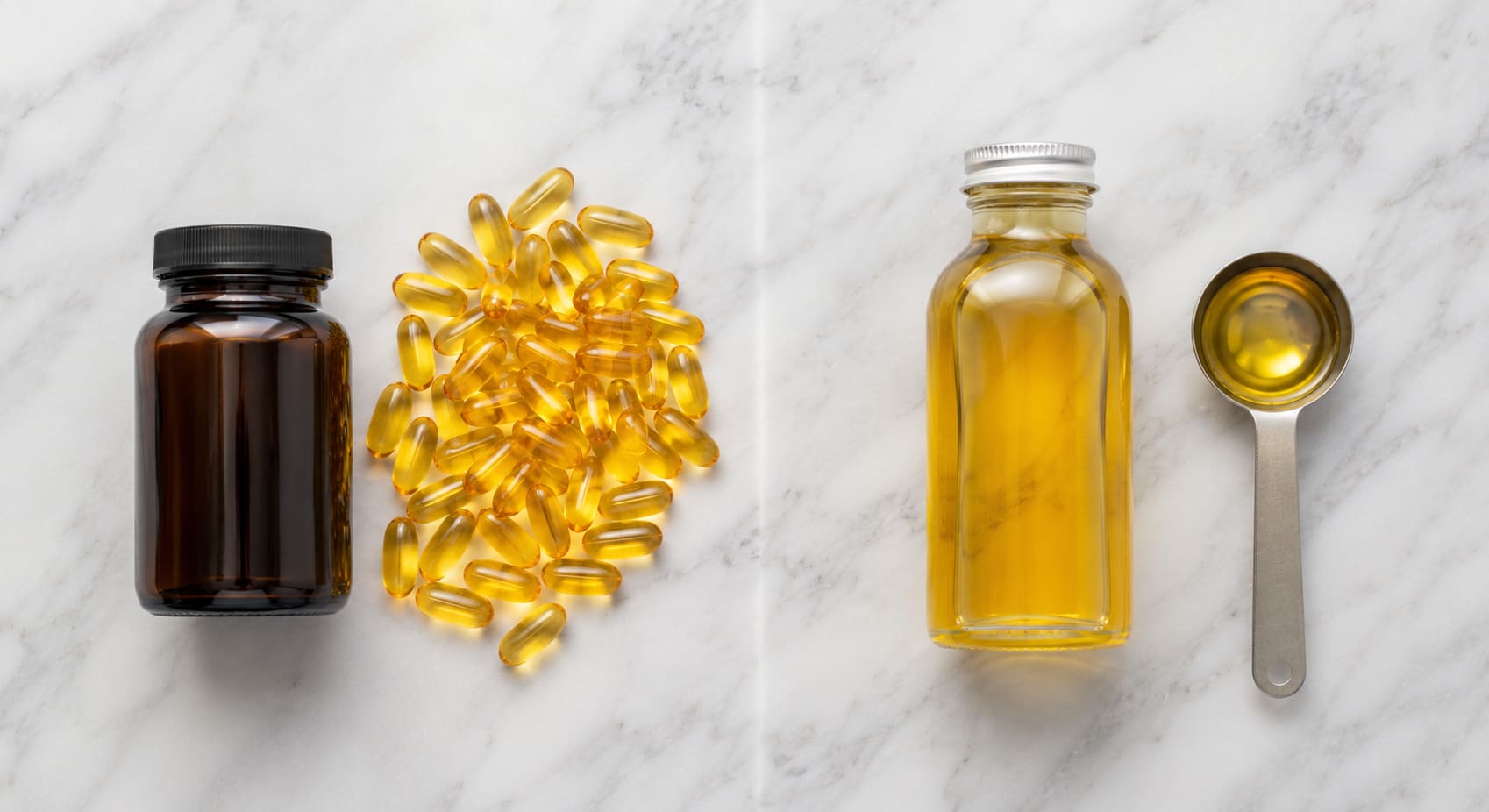
Advantages of capsules: convenience, no fishy taste, precise dosage, long shelf life. Cons: more expensive than liquid, some people are sensitive to the gelatin оболонку. Best suited for: adults and teenagers who value convenience and lack of taste. Liquid fish oil is also taken with food, 1–2 tsp per day.
How to take fish oil capsules – tips for effectiveness
How to improve absorption, what to combine with, and common mistakes
How to improve absorption: take with fatty foods (nuts, avocado, olive oil), store in the refrigerator after opening, choose the triglyceride form (rTG).
What to combine with: vitamin D (synergy for immunity and bones), vitamin E (antioxidant protection for omega-3), curcumin (enhanced anti-inflammatory effect), coenzyme Q10 (cardiovascular protection).
Common mistakes:
- Taking it on an empty stomach and quitting because of nausea.
- Looking at the capsule weight, not the omega-3 content.
- Buying a cheap product with oxidized oil (a bitter taste is a sign).
- Expecting an effect within a week (realistically 4–8 weeks).
- Taking it together with anticoagulants without consulting a doctor.
How to take fish oil capsules – FAQ
Can you take fish oil every day
Yes, daily intake at preventive doses (500–1000 mg omega-3) is safe for most healthy adults. At high doses (above 2 g)—take in courses with breaks and under a doctor’s supervision.
How long until you see an effect
The first changes in well-being appear after 4–6 weeks. Improvements in triglycerides and cholesterol on lab tests—after 8–12 weeks of regular intake.
Can you take it on an empty stomach
Fish oil can formally be taken on an empty stomach, but it’s not recommended: absorption is worse and the risk of nausea is higher. The best option is with fatty foods.
What omega-3 dosage is optimal
For most healthy adults—500–1000 mg EPA+DHA per day. For cardiovascular disease or high triglycerides—1000–2000 mg under a doctor’s supervision. Always look at the omega-3 content on the label, not the capsule weight.
Sources
- Manson J.E. et al. Marine n-3 Fatty Acids and Prevention of Cardiovascular Disease and Cancer. NEJM, 2019.
- Calder P.C. Omega-3 fatty acids and inflammatory processes. Nutrients, 2010.
- NIH Office of Dietary Supplements. Omega-3 Fatty Acids – Fact Sheet for Health Professionals. 2023.
If you need help choosing fish oil for your goal, Lavka Molfara offers verified products with IFOS quality certificates.






Write a comment